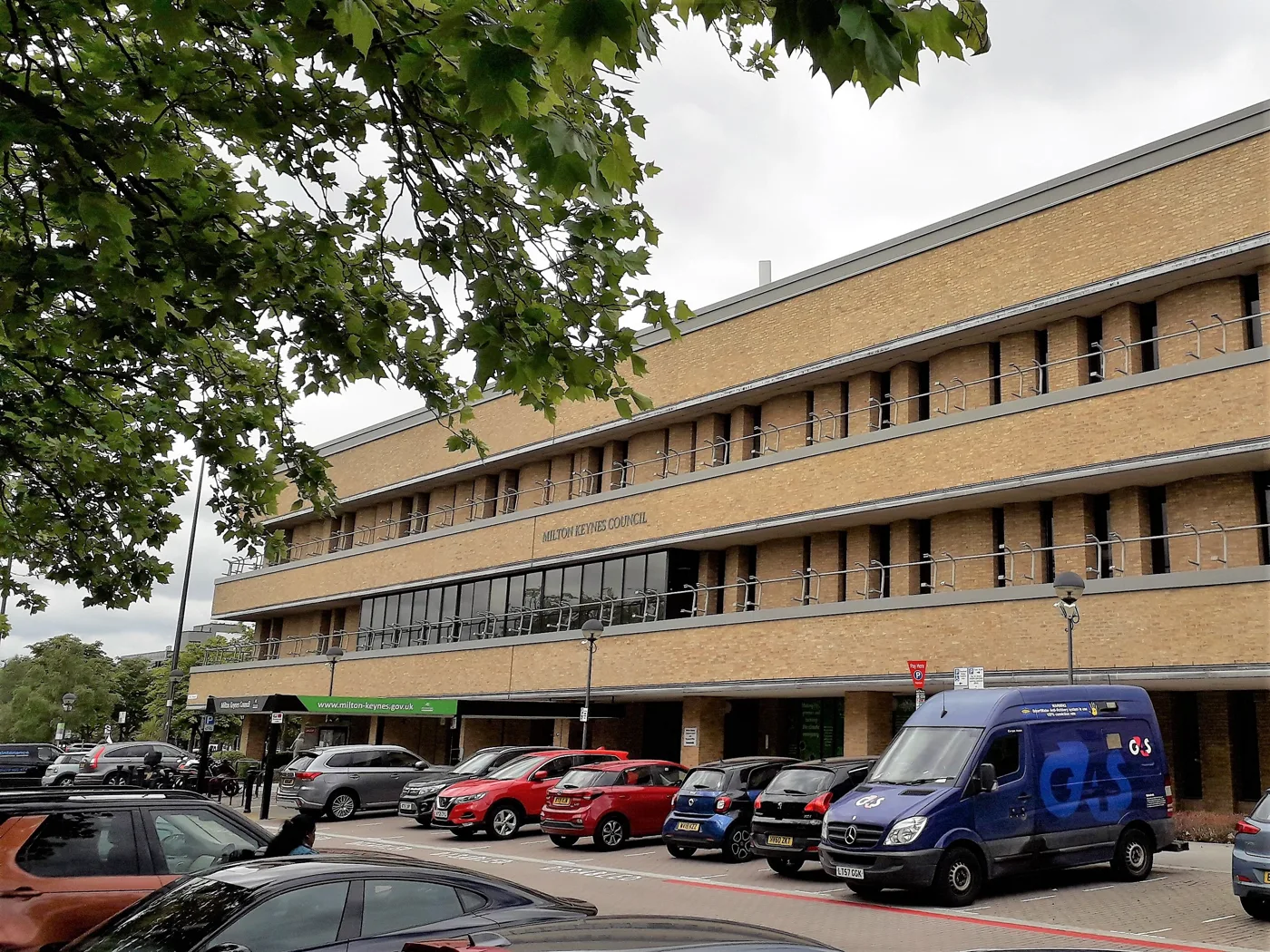

From 31 October no ward councillor, parish council or resident can send a Milton Keynes planning application to committee. Officers must decide the small ones.
From 31 October a ward councillor, a parish or town council, or a resident in Milton Keynes will no longer be able to force a planning application in front of the Planning Committee. The right to do that is being removed, and the council says it has no choice.
Extensions, schemes of up to nine homes and minor commercial works will be decided by planning officers under delegated powers. They cannot go to committee at all, however many objections they attract.
The change is set out in a constitutional report that went to Milton Keynes City Council’s Planning Committee on Thursday 3 September.
What is changing
The government has made the Town and Country Planning (Discharge of Local Planning Authority Functions) (England) Regulations 2026 under the Planning and Infrastructure Act 2025. They come into force on 31 October, and they replace every council’s own rules on which applications go to committee.
The regulations sort applications into two schedules.
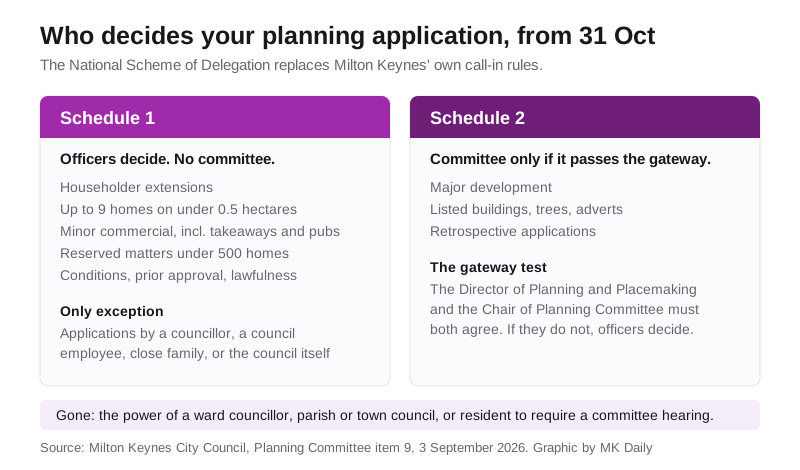
Schedule 1 must be decided by officers. It cannot be referred to committee. The council’s report lists what falls in it:
- householder development, minor commercial development and minor residential development
- reserved matters for outline permissions of fewer than 500 dwellings or 50,000 square metres of floorspace
- applications to vary or remove a condition where the original permission was a Schedule 1 application
- permission in principle
- discharge of planning conditions, including the biodiversity gain condition
- prior notification and prior approval under permitted development rights
- requests to modify or discharge a planning obligation connected to a Schedule 1 application
- non-material changes to a planning permission
- certificates of lawfulness, and certificates of appropriate alternative development
“Minor residential development” is defined as up to nine new homes on a site smaller than 0.5 hectares. “Minor commercial development” covers shops, cafes and offices in Class E, plus pubs and hot food takeaways, where there is no change of use and no extra floorspace.
Schedule 2 can go to committee, but only if two people agree. It covers major development, works to listed buildings, works to trees, advertisement consent and retrospective applications. The government calls this “delegation by default”.
The gateway test, and who applies it
A Schedule 2 application only reaches the committee if it passes what the regulations call the gateway test. Both a nominated officer and a nominated member must agree that it raises:
- one or more issues of economic, social or environmental significance to the local area; or
- one or more significant planning matters, having regard to the development plan and other material considerations
In Milton Keynes the nominated officer will be the Director of Planning and Placemaking. The nominated member will be the Chair of Planning Committee.
If the two of them do not agree, the application is decided under delegated powers. Nobody else can overturn that call.
The report is blunt about what this removes. Applications “will no longer automatically go to committee simply because they attract a certain number of objections or are ‘called in’ by a ward councillor or parish/town council under existing local arrangements”. The national scheme, it says, “effectively makes any such provision unlawful”.
One exception, and one committee lost
There is a single carve-out. Applications submitted by a councillor, by a council employee, or by their parents, children, siblings or partners can still be referred to committee. So can applications made by the council itself, or by a company it owns or controls. These are the “own interest” applications, and again the nominated officer and nominated member must agree.
The council is also deleting the rule that lets Planning Committee set up a Planning Panel. That panel currently decides residential schemes under 10 homes and commercial schemes under 1,000 square metres, along with householder applications and listed building consent. Nearly all of that work is now Schedule 1, so the panel has nothing left to do. Officers expect “the majority of Planning Panel business (Schedule 1) will fall away”, while the volume going to Planning Committee itself “will remain relatively stable”.
Why the council says it cannot refuse
Milton Keynes last reviewed its own scheme of delegation in September 2023. The report warns that leaving it as it is would expose the council’s decisions. It quotes the government’s statutory guidance directly:
“Where local planning authorities do not comply with the Regulations from the date they come into force (31 October 2026) and their planning committees make decisions on applications which must be delegated officers, those decisions may be subject to judicial review by anyone aggrieved by the decision. This may lead to the quashing of the decision.”
What happens next
Planning Committee considered the report as item 9 on 3 September. The council’s published decision sheet for that meeting records outcomes for the six planning applications and the tree preservation order it dealt with, and does not record one for the constitutional item. The minutes are due at the committee’s next meeting on 1 October.
The changes need full Council to agree them. Council next meets on Wednesday 23 September at 7.30pm, according to the council’s meetings calendar. The regulations bite on 31 October regardless.
What it means for you
You keep the right to comment on an application, and the right to register to speak at Planning Committee. What you lose is the ability to insist an application is heard there.
That changes how an objection should be written. The council’s own guidance note tells consultees, including residents and parish councils, to spell out why an application meets the gateway test. It suggests pointing to:
- the scale and nature of the development, giving a strategic urban extension already allocated in the development plan as its example
- the planning history of the site, especially a complex history that includes appeals allowed
- the sensitivity of the site, where a proposal could significantly harm a heritage, biodiversity or landscape asset
- a material conflict with the council’s approved planning policies
A comment that says only “too big” or “too many objections locally” will not clear the gateway. One that names the policy the scheme conflicts with, and says why the harm is significant, might.
If a neighbour’s extension or a nine-home infill scheme is what worries you, none of that will help after 31 October. Those decisions belong to officers. You can still object, and officers must take material planning considerations into account, but the committee route is closed.
We track decisions as they are published on our Milton Keynes planning news page.
Sources
- Milton Keynes City Council, Constitutional Report: Proposed Amendments to the Officer Scheme of Delegation on Development Management Matters, Planning Committee item 9, 3 September 2026
- Milton Keynes City Council, Planning Committee agenda and decisions, 3 September 2026
- Milton Keynes City Council, calendar of meetings, September 2026
- Ministry of Housing, Communities and Local Government, Planning Committees and the National Scheme of Delegation of Planning Functions: guidance for local planning authorities in England
Have your say