
Taxi licence fees will not rise in April 2027 after three years of surplus, council officers say. Pub, scrap metal and gambling fees still go up 2.9%.
Taxi and private hire licence fees in Milton Keynes will not go up in April 2027. Council officers have told councillors they cannot lawfully justify another increase, because the service has run a surplus for three years running.
That breaks a run of six consecutive annual rises. The most recent, on 1 April 2026, added 3.8% to driver, vehicle and operator licences.
The position is set out in a briefing note on taxi licensing fees and charges prepared by Adele Wearing, the council’s Strategic Lead for Passenger Transport and Taxi Licensing, and dated 16 September. The Regulatory Committee resolved that the note be noted at its meeting the same evening.
Why the freeze
The council’s own income policy says fees and charges should rise by 2.9% next year, the July 2026 CPI figure. Taxi licensing is the exception.
Officers write that fees “should not be increased for 2027/28 due to the number of surpluses that have accrued in recent years”, and that while those surpluses are being lawfully used to cover shortfalls and to pay for new taxi licensing and enforcement software, they “cannot lawfully justify any further increases for 2027/28”.
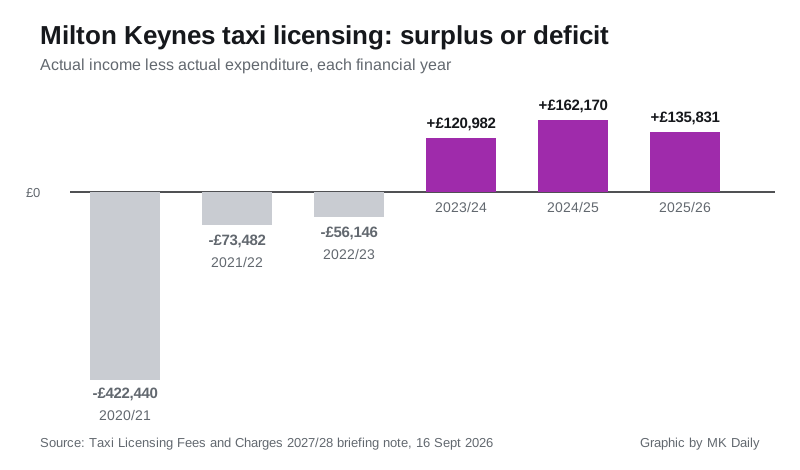
The note publishes six years of actual figures. The service lost money heavily in 2020/21, then turned around:
- 2020/21: £314,417 in, £736,857 out, a deficit of £422,440
- 2021/22: £436,475 in, £509,957 out, a deficit of £73,482
- 2022/23: £499,227 in, £555,373 out, a deficit of £56,146
- 2023/24: £628,869 in, £507,887 out, a surplus of £120,982
- 2024/25: £690,443 in, £528,273 out, a surplus of £162,170
- 2025/26: £713,981 in, £578,150 out, a surplus of £135,831
The last three years add up to £418,983 more taken in than spent. The note records that the 2025/26 budget surplus of £76,653 went into reserves, to cover future shortfalls or one-off costs such as setting up the new licensing software.
The law is the reason this matters. Sections 53 and 70 of the Local Government (Miscellaneous Provisions) Act 1976 let a council charge for taxi licensing only to recover its costs. The briefing note cites three judgments on the point, R (Cummings) v Cardiff Council in 2014, R (Rehman) v Wakefield Council in 2019 and R v Manchester City Council in 1991, and Local Government Association guidance that councils “must not use fees to make a profit or act as an economic deterrent”.
The enforcement bill the council cannot charge for
A separate document, on the Full Council agenda for Wednesday 23 September, puts a number on where that enforcement money goes.
Motion 1, Strengthening Local Taxi and Private Hire Licensing, was tabled on 4 September by the council leader, Councillor Jane Carr. It goes to the Council meeting on Wednesday 23 September. The motion states that:
- around 45% of licensed vehicles working in Milton Keynes are licensed by other authorities, among them Buckinghamshire, London, Wolverhampton, Luton, Bedfordshire and West Northamptonshire
- council officers carried out 2,132 checks on out-of-area drivers and vehicles in 2025
- roughly 45% of licensing enforcement time went on vehicles licensed elsewhere, and the council cannot recover those costs
- the council received 89 complaints about out-of-area drivers and vehicles that year, all of which had to be passed to the authority that issued the licence
- ten prosecutions of drivers licensed by other authorities succeeded
Private hire vehicles have been able to work outside the area that licensed them since the Deregulation Act 2015. The motion notes that Milton Keynes went to court to try to restrict that and the High Court ruled against the council in 2017.
The motion asks the cabinet member for taxi licensing to write to the Minister for Buses and Local Transport, calling for drivers to be licensed where they mainly work or live and for enforcement costs to fall on the authority that issued the licence. We will report what councillors decide.
Everything else goes up 2.9%
The freeze is specific to taxis. Two other fee schedules were endorsed on the same evening and both carry the inflation increase.
The Licensing Fees 2027/28 report went to the Regulatory Committee, which endorsed it. Its annex lists every discretionary fee. Examples, current fee first:
- sex establishment venue, new licence: £4,240 to £4,363, plus a grant fee up from £555 to £600
- street trading, new licence up to three hours: £660 to £679
- scrap metal collector licence, three years: £458 to £471
- scrap metal site licence, three years: £594 to £611
- body piercing or acupuncture premises registration: £325 to £334
- registering a business or activity: £350 to £360
- a hypnotism performance application: £105 to £108
- late application for a child performance licence: £30 to £31
Some fees are held flat because they already sit at cost recovery, including the borough wide mobile operator licence at £2,939 and its renewal at £1,400. One new charge appears: £60 for additional vehicles under a fixed site multiple traders consent.
Two rows in the annex do not add up. Street trading’s new licence for up to three hours moves from £660 to £679, which is £19, but the change column says £17. An additional scrap metal site moves from £296 to £305, which is £9, but the change column says £19. The fee figures themselves are consistent with a 2.9% uplift.
Gambling fees are stuck at 2007 levels
The Gambling Act 2005 fees report went to the Licensing Committee, which endorsed it. The council has discretion over 42 gambling fees, and most of them cannot move.
The reason is in the report. Parliament set the fee bands in 2007 and never updated them, and the council puts the erosion since then at “roughly 74%”. A large casino application stays at £10,000 and a bingo premises application at £3,500, both already at the statutory maximum.
Where there is room, the fees rise:
- large casino annual subsistence: £3,313 to £3,410
- bingo subsistence: £931 to £958
- betting shop provisional licence: £2,757 to £2,837
- betting shop transfer: £659 to £678
- track betting subsistence: £978 to the £1,000 statutory ceiling
What it means for you
Nothing changes yet. All of these figures are proposals. Both committees endorsed them for the budget setting process that starts in October 2026, with adoption through the council budget in March 2027 and the new fees taking effect in April 2027. The council’s medium term financial plan sets out the rest of that timetable.
If you hold a Milton Keynes taxi or private hire licence, budget for no increase next April. It is the first standstill after six consecutive rises. If you run a market stall, a scrap metal round, a tattoo or piercing studio or a betting shop, add 2.9%.
If you want to object, the committee stage has passed but the fees still have to go through full budget setting. Public questions to Council close at 7.30pm on the Monday before each meeting.
For the other charges the council sets locally, see our guides to parking in Milton Keynes and council tax bands.
Sources
- Milton Keynes City Council, Taxi Licensing Service, Annual Fees and Charges 2027/28, briefing note dated 16 September 2026
- Regulatory Committee, 16 September 2026, agenda, reports and decisions
- Licensing Committee, 16 September 2026, agenda, reports and decisions
- Licensing Fees 2027/28 and its annex of proposed fees
- Gambling Act 2005 Fees 2027/28 and its annex of proposed fees
- Notice of Motion 1, Strengthening Local Taxi and Private Hire Licensing, Council, 23 September 2026
Have your say